
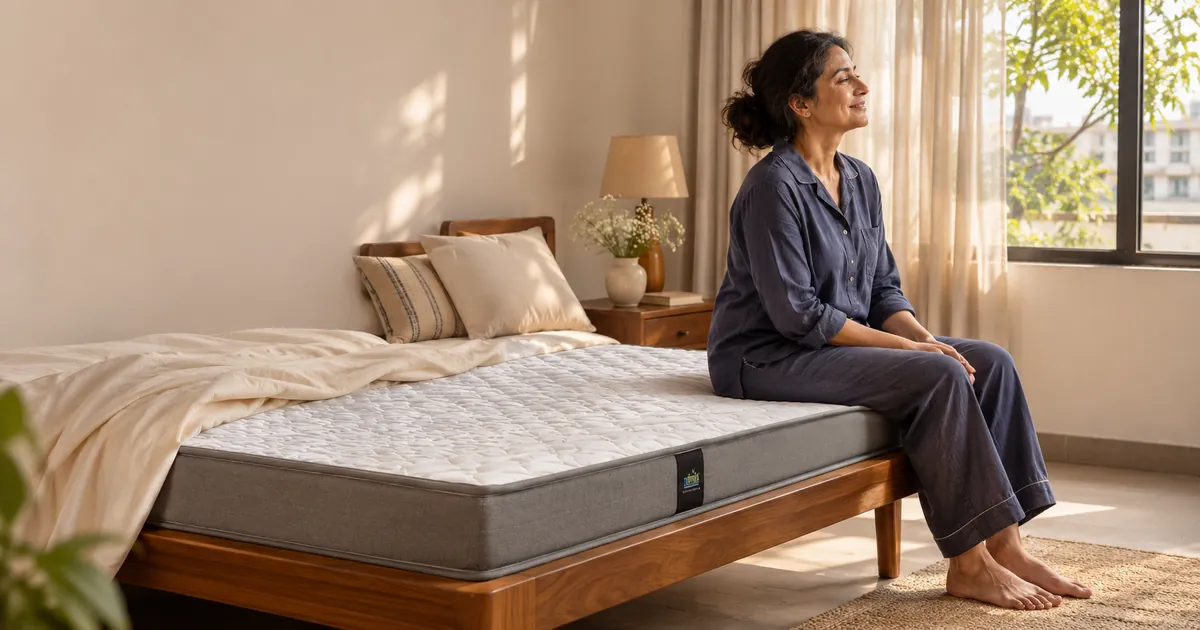
Quick answer: For most people with back pain, a medium-firm mattress is the best choice. It supports the spine in a straight line and still cushions the shoulders and hips. Choose firm if you are heavier or sleep on your back, and soft only if you sleep on your side and are light. If the pain is ongoing, see a doctor as well.
Why mattress firmness matters for back pain
Your spine has natural curves. When you lie down, a good mattress keeps those curves close to how they look when you stand. If the bed is too soft, the heavier parts of your body (hips and shoulders) sink in and the spine bends sideways or sags. If it is too hard, the mattress does not follow the curve of your waist, and pressure builds at the shoulders, hips and lower back.
Many people believe a very hard bed is best for a bad back. Research does not support that. In a well-known randomised trial of 313 adults with long-term lower back pain, people given medium-firm mattresses had less pain lying in bed, less pain on getting up and less disability after 90 days than people given firm mattresses (Kovacs et al., The Lancet, 2003). A later review of 39 studies reached a similar conclusion: medium-firm mattresses were linked with better comfort, sleep quality and spinal alignment (Journal of Orthopaedics and Traumatology, 2021).
The evidence is not perfect. Studies use different ways to measure firmness, and the effects are modest. A mattress can reduce night-time and morning pain, but it does not cure the cause of the pain. Treat medium firm as a sensible starting point, then adjust to your body weight and sleeping position.
Firm, medium-firm or soft: which one suits you
| Feel | Best for | Watch out for |
|---|---|---|
| Firm | Back sleepers, heavier adults, people who like a flat, hard bed | Can feel hard on shoulders and hips for side sleepers |
| Medium firm | Most people with back pain, couples, mixed sleeping positions | Not the right pick if you want a very plush feel |
| Soft | Light side sleepers who want pressure relief | Body can sink in and the spine may curve, which can make back pain worse |
What to look for in a back pain mattress
- Support first. Your spine should stay level when you lie down. Rebonded foam and high density foam hold their shape well.
- Right firmness for your sleeping position. Back sleepers need firmer support; side sleepers need a little give at the shoulders and hips.
- Enough thickness. For adults, 5 inches or more gives better support than a thin 4 inch mattress.
- A long guarantee. A longer guarantee shows the maker expects the foam to hold up and not sag.
- Try before you buy. Lie on it in your usual position for a few minutes at a showroom.
Best sleeping position for back pain
The right position and a few pillows can help as much as the mattress.
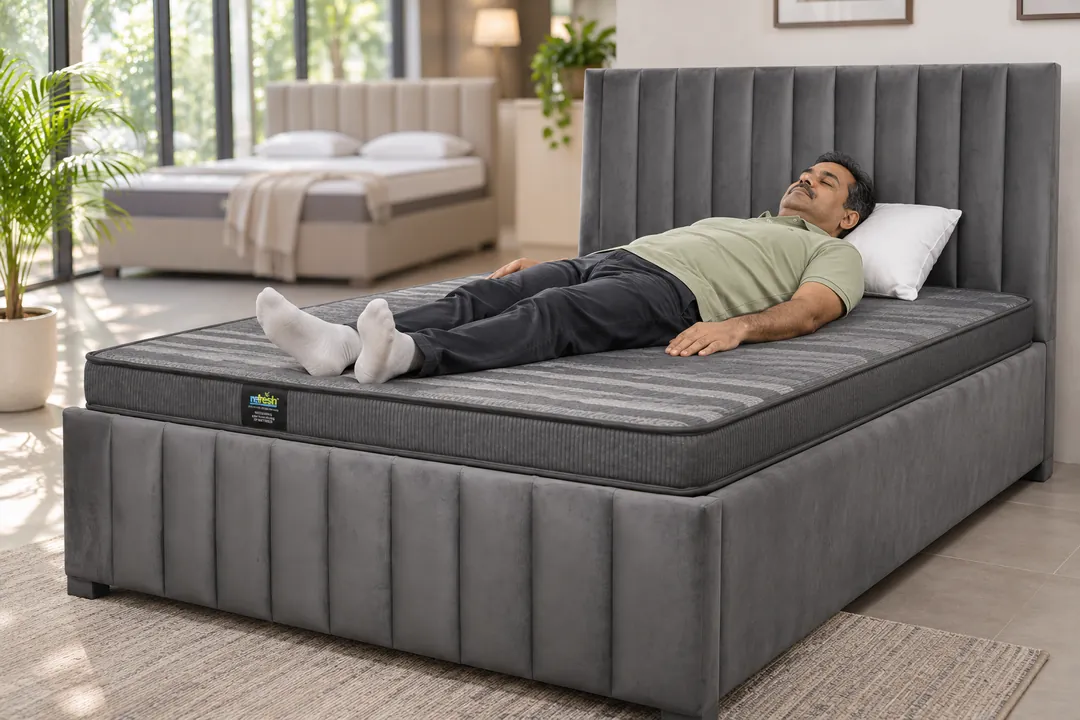
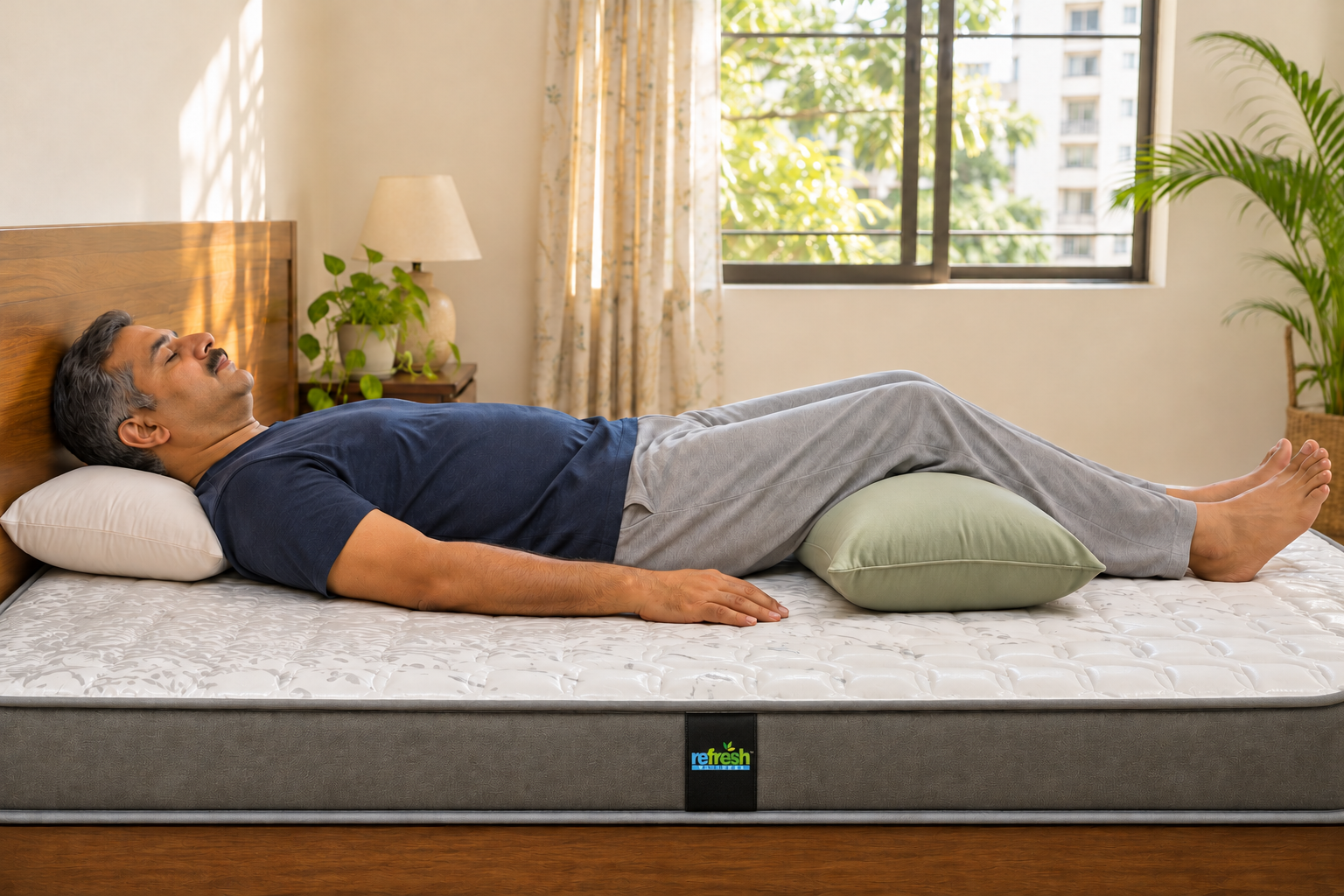
- On your back: Usually the easiest position for the spine. Put a thin pillow under your head and a pillow under your knees. This keeps the lower back from arching and takes strain off the muscles.
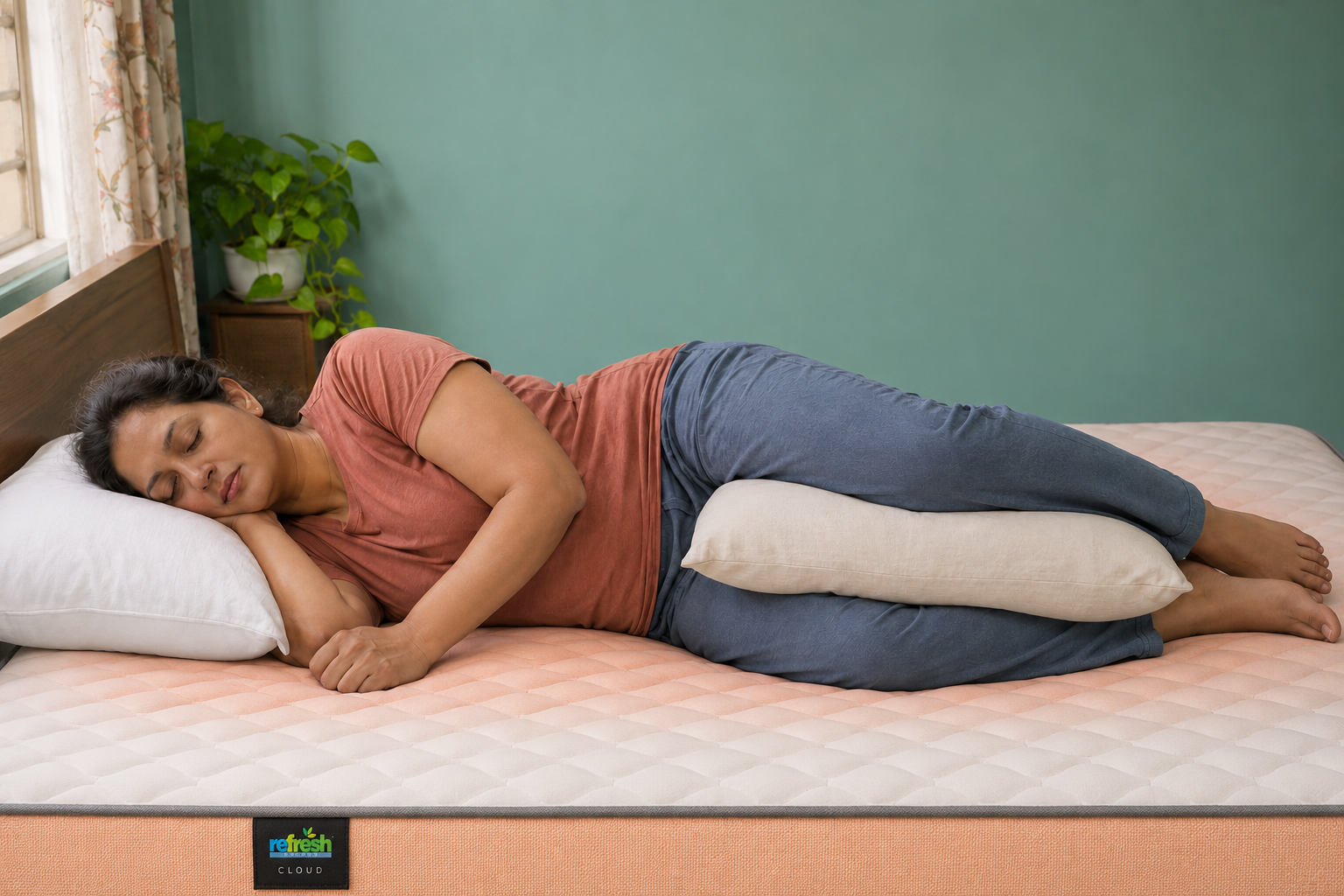
- On your side: Also a good choice. Keep your knees slightly bent and put a pillow between them so the hips and pelvis stay level. Use a pillow thick enough to keep your head in line with your spine.
- On your stomach: The hardest on the back and neck, because the lower back arches and the head turns to one side. If you cannot change, put a thin pillow under your belly and use a very flat pillow, or none, under your head.
Heavier people press deeper into a mattress, so they often need a firmer, thicker one to keep the spine level. Lighter people may find a medium-firm mattress is enough and a firm one feels hard.
Signs your mattress is the problem
- You wake with back stiffness that eases within an hour of moving around.
- You sleep better on a hotel bed or a guest bed than on your own.
- You can see or feel a dip where you usually lie.
- The mattress is 8 to 10 years old, or foam has started to sag.
Refresh Mattress models for back support
These single bed models are built for firm or medium-firm support. Prices are for the single size and can change, so check the product page.
| Model | Feel | Thickness | Guarantee | Price from |
|---|---|---|---|---|
| Spinetec Firm Virgin Rebonded Foam | Firm | 5" | 8 years | ₹8,135 |
| Spinetec Active Firm Rebonded Foam | Firm | 5" | 8 years | ₹9,490 |
| Orthobed Super Hard Rebonded Foam | Firm | 4.5" | 10 years | ₹10,032 |
| Crown Rebonded Foam | Medium firm | 5" | 5 years | ₹7,949 |
| Crown Plus Medium Firm Foam | Medium firm | 6" | 5 years | ₹9,765 |
| Comfort Rebonded Foam | Medium firm | 5" | 8 years | ₹9,832 |
| Cloud High Density Foam Back Support | Soft | 5" | 10 years | ₹7,480 |
Browse all options on the single bed mattress page.
Questions people ask
Is a hard mattress good for back pain?
Not always. A very hard mattress can press on the shoulders and hips. Medium firm suits most people, and firm suits back sleepers and heavier adults.
Is memory foam good for back pain?
It can be, if it is dense enough to keep your spine level. Soft memory foam that lets your hips sink can make pain worse for some people.
Which is better for back pain, foam or spring?
A good rebonded or high density foam mattress gives steady, even support. Spring mattresses can also work, but check that the top layer does not sag.
What thickness is best for back pain?
For adults, 5 inches or more is a good starting point. Heavier people may prefer 6 inches.
How long before a new mattress helps?
Give it two to four weeks to adjust. If the pain stays or gets worse, try the mattress at a showroom or talk to a doctor.
Can a bad mattress cause back pain?
A worn-out or unsuitable mattress can make existing back pain worse and leave you stiff in the morning. Most back pain has other causes too, such as muscle strain, long hours of sitting, weak core muscles or an old injury, so changing the mattress alone may not fix it.
Is a firm mattress better than a medium-firm one for a slipped disc?
No mattress treats a slipped disc. Most people with disc pain are more comfortable on a medium-firm surface with the right sleeping position, but follow your doctor's advice for your case.
Should I sleep on the floor for back pain?
It is not recommended as a treatment. A very hard surface does not follow the curve of your spine, and research favours medium-firm over very firm surfaces.
How often should I replace my mattress?
Replace it when it sags, feels uneven or no longer supports you, which is often after 8 to 10 years for foam. A longer guarantee is a useful sign of build quality, but check the terms.
When to see a doctor
A mattress can make sleep more comfortable, but it does not treat the cause of back pain. Most back pain is not serious and improves within a few weeks, and staying gently active usually helps more than bed rest. See a doctor if:
- The pain lasts more than 4 to 6 weeks or keeps coming back.
- The pain wakes you at night or is worse when you lie down.
- The pain spreads down one or both legs, or you feel numbness or tingling.
- Your legs feel weak.
- The pain began after a fall, accident or injury.
- You have a fever, or you are losing weight without trying.
Get urgent medical help straight away if back pain comes with trouble passing urine or stool, numbness around the groin or inner thighs, or sudden weakness in both legs. These can be signs of a serious nerve problem that needs treatment quickly.
This article is general information and is not a substitute for medical advice.


 />
